TFL
The TfL data shows how many bikes were hired every single day. We can get the latest data by running the following
url <- "https://data.london.gov.uk/download/number-bicycle-hires/ac29363e-e0cb-47cc-a97a-e216d900a6b0/tfl-daily-cycle-hires.xlsx"

# Download TFL data to temporary file
httr::GET(url, write_disk(bike.temp <- tempfile(fileext = ".xlsx")))
# Use read_excel to read it as dataframe
bike0 <- read_excel(bike.temp,
sheet = "Data",
range = cell_cols("A:B"))
# change dates to get year, month, and week
bike <- bike0 %>%
clean_names() %>%
rename (bikes_hired = number_of_bicycle_hires) %>%
mutate (year = year(day),
month = lubridate::month(day, label = TRUE),
week = isoweek(day))We can easily create a facet grid that plots bikes hired by month and year.
 general_monthly_average <- bike %>%
  filter(year>=2016 & year<=2019) %>%
  group_by(month) %>%
  summarise(general_monthly_average = mean(bikes_hired))

monthly_average <- bike %>%
  filter(year>=2016) %>%
  group_by(year, month) %>%
  summarise(monthly_average = mean(bikes_hired),
            year = unique(year))

full_monthly_averages <- left_join(monthly_average, general_monthly_average, by="month")

full_monthly_averages %>%
  ggplot(aes(x=month, group=1)) +
  geom_line(aes(y=monthly_average)) +
  geom_line(aes(y=general_monthly_average),
            color = "blue",
            size=0.8) +
  geom_ribbon(aes(ymin = ifelse(general_monthly_average > monthly_average, general_monthly_average, monthly_average),
                  ymax = general_monthly_average),
              fill = "palegreen3",
              alpha = 0.5)+
  geom_ribbon(aes(ymin = ifelse(general_monthly_average <= monthly_average, general_monthly_average, monthly_average),
                  ymax = general_monthly_average),
              fill = "lightcoral", alpha = 0.5) +
  facet_wrap(~year) +
  labs(title = "Monthly changes if Tfl bike rentals",
       subtitle="Change from monthly average shown in blue \nand calculated between 2026-2019",
       y = "Bike rentals",
       x = "Months"
  ) +
  theme_minimal() +
  theme(
    axis.text.x = element_text(size = 6),
    axis.text.y = element_text(size = 6)
    ) +
  NULL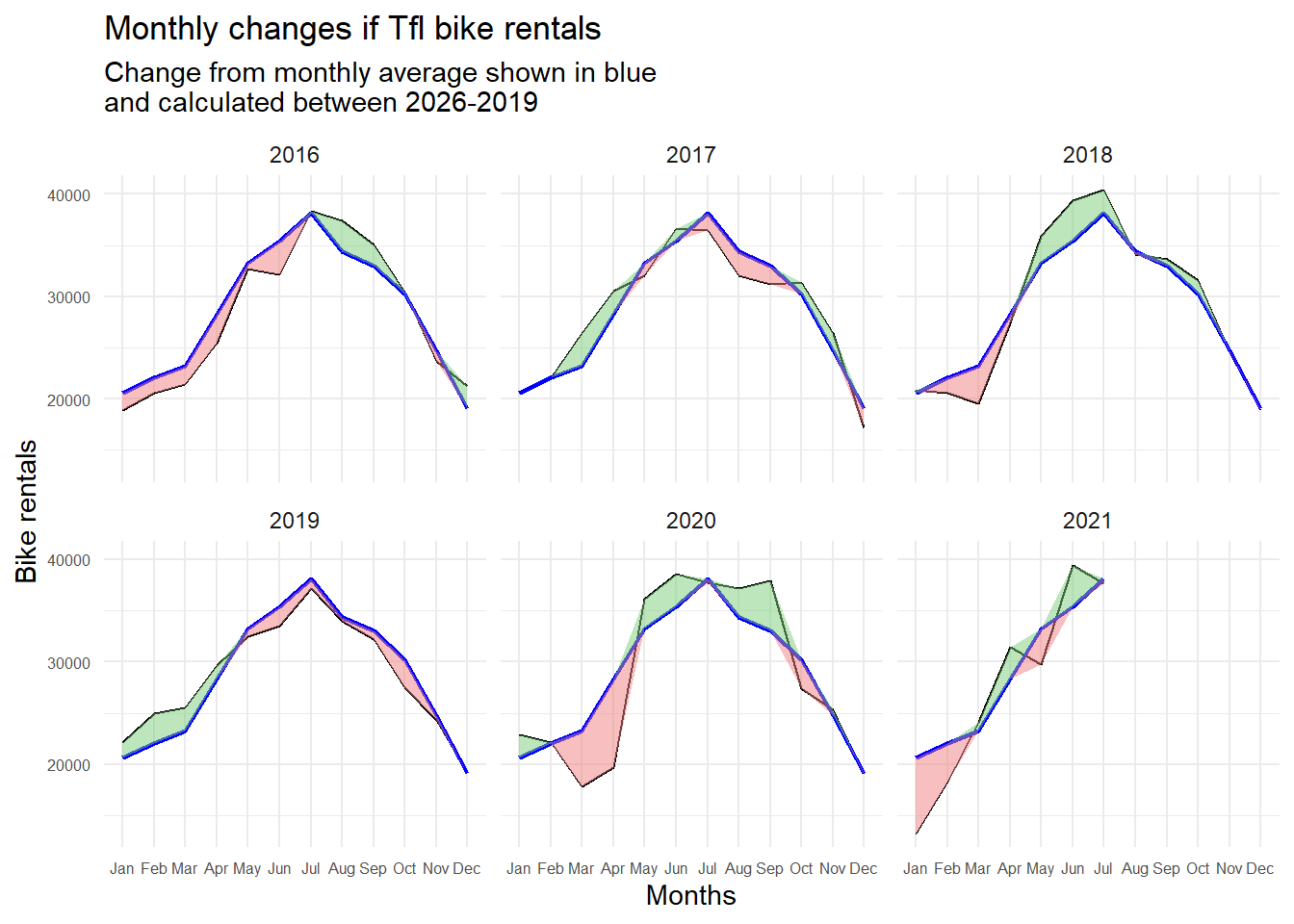
We can see that in the month of May and June 2020, bike rentals went down immensely, compared to previous years. This can be attributed to the national lockdowns that were enforced due to the COVID-19 pandemic during that time.
The second one looks at percentage changes from the expected level of weekly rentals. The two grey shaded rectangles correspond to Q2 (weeks 14-26) and Q4 (weeks 40-52).
expected_bike_pw <- bike %>%
  filter(day >= as.Date("2016-1-1") & day <= as.Date("2019-12-31")) %>%
  group_by(week) %>%
  summarise(expected_rentals = mean(bikes_hired))

bike_pw <- bike %>%
  filter(year >= 2016 & !(year == 2021 & week > 30)) %>%
  group_by(year, week) %>%
  summarise(actual_rentals = mean(bikes_hired)) %>%
  left_join(expected_bike_pw, by="week") %>%
  mutate(excess_rentals = actual_rentals - expected_rentals,
         excess_rentals_inpct = excess_rentals/expected_rentals)
weekly_plot <- bike_pw %>%
ggplot(aes(x = week)) +
geom_line(aes(y = excess_rentals_inpct),
color = "black",
size = 0.1) +
geom_ribbon(aes(ymin = ifelse(excess_rentals_inpct > 0, 0, excess_rentals_inpct),
ymax = excess_rentals_inpct),
fill = "green4", alpha = 0.3) +
geom_ribbon(aes(ymin = ifelse(excess_rentals_inpct > 0, excess_rentals_inpct, 0),
ymax = excess_rentals_inpct),
fill = "red", alpha = 0.3) +
geom_rug(color = ifelse(bike_pw$excess_rentals_inpct > 0 , "green", "red"),
alpha = 0.5,
size = 0.3) +
annotate("rect",xmin = 13, xmax = 26, ymin = -Inf, ymax = Inf, fill = "grey", alpha = 0.3) +
annotate("rect",xmin = 39, xmax = 53, ymin = -Inf, ymax = Inf, fill = "grey", alpha = 0.3) +
scale_y_continuous(labels = scales::percent) +
scale_x_continuous(breaks = seq(13,53,by=13)) +
facet_wrap(~year) +
theme_minimal() +
theme(plot.title = element_text(size=7, face="bold"),
plot.subtitle = element_text(size=6, face="bold"),
axis.text.y = element_text(size=5),
axis.text.x = element_text(size=5),
axis.title.x = element_text(size=5, face="bold"),
strip.text = element_text(size=5),
plot.caption = element_text(size=5),
panel.grid.major = element_line(size=0.1),
panel.grid.minor = element_line(size=0.1)) +
labs(title = "Monthly changes in TfL bike rentals",
subtitle = "% change from weekly averages \n calculated between 2016-2019",
y = "",
x = "week",
caption = "Source: TfL, London Data Store")
weekly_plot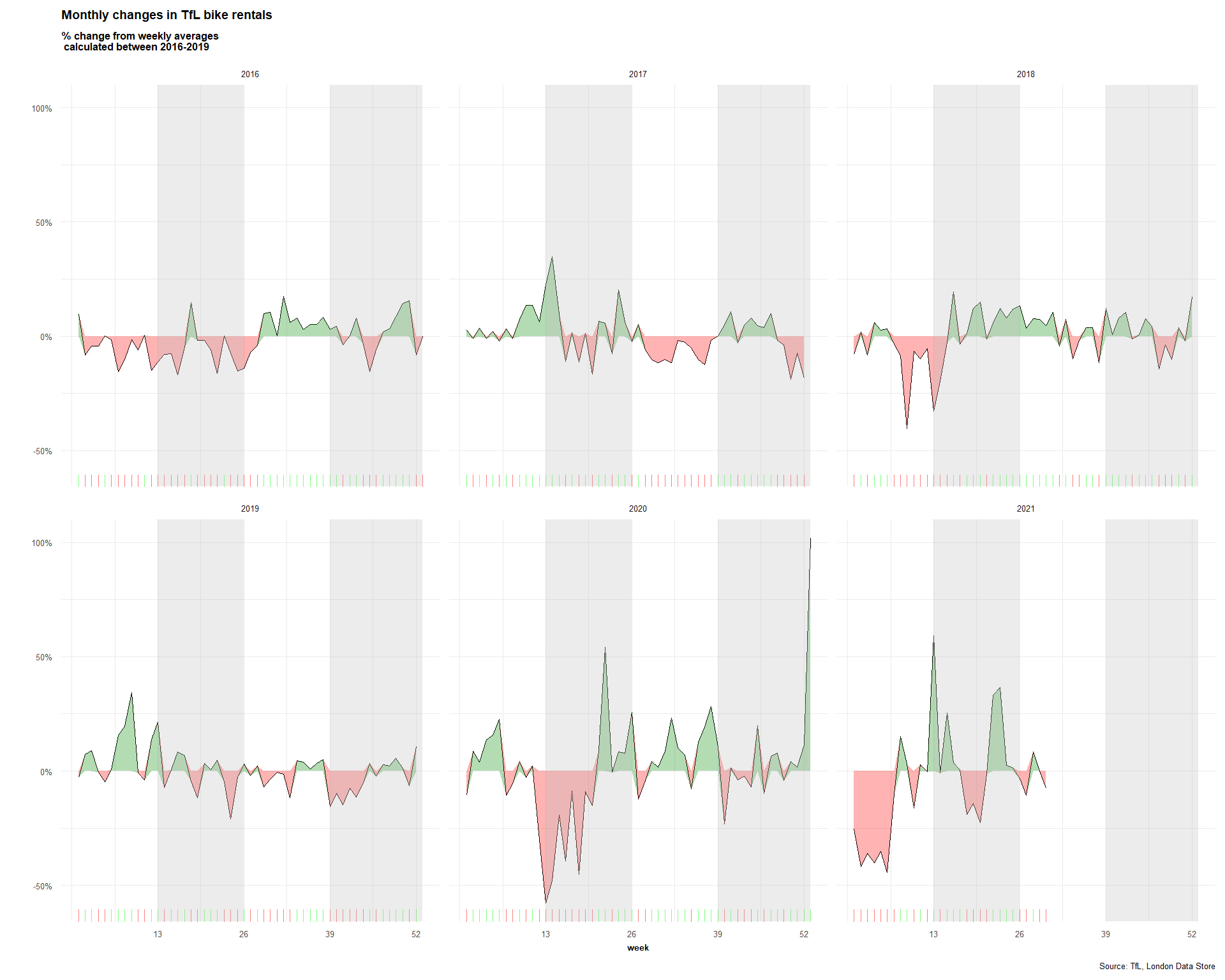
For both of these graphs, we calculate the expected number of rentals per week or month between 2016-2019 and then, we see how each week/month of 2020-2021 compares to the expected rentals.
Note: We can see massive spikes in the previous graph, so it might be more useful to use the median rather than the mean, as extreme values won’t affect it as much.